
Iranian Foreign Minister Abbas Araghchi is in India for a BRICS foreign ministers' meeting, where discussions will focus on the escalating crisis in West Asia and its impact on global energy supply chains.

Prime Minister Narendra Modi's visit to Israel aims to strengthen the strategic partnership between the two nations, focusing on cooperation in various sectors including defense, technology, and trade.

Former world blitz and rapid champion Anna Muzychuk discusses the upcoming World Chess Championships, highlighting the importance of psychological momentum and pressure handling for Indian players D Gukesh and R Vaishali.

Historically, India was a major buyer of Iranian crude, importing significant volumes of Iranian light and heavy grades due to strong refinery compatibility and favourable commercial terms.

Amid escalating tensions, Iranian Deputy Foreign Minister Saeed Khatibzadeh declares Iran's unwavering commitment to a 'heroic nationalist defence' against perceived American and Israeli aggression, vowing to resist what he calls an 'invasion' to the very end.

Iran is fighting a different war: Older, slower, and in some ways more dangerous. Iran doesn't need to shoot down an F/A-18. It only needs to make the Strait of Hormuz feel dangerous long enough for insurance markets, shipping companies, and oil futures traders to do the rest. Prem Panicker continues his must-read daily blog on the war in the Middle East.

On Saturday, it was reported that a drone strike had targeted the Fujairah Port in the UAE, triggering a fire.

'Even if the war ends tomorrow, which is unlikely, and we go back to the pre-war status quo, the world will still need some time to get over the sudden shock of oil price increases.'

Indian airports are rapidly becoming a significant growth avenue for the country's retail sector, with brands across various consumer segments actively opening stores to tap into the increasing number of flyers and strong domestic tourism momentum.

There are enough people at the top decision-making level in Tehran who are still willing to negotiate, provided Trump can create the right setting for the negotiation to acquire a dynamic of its own, points out Ambassador M K Bhadrakumar.
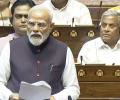
Prime Minister Narendra Modi addresses the Rajya Sabha, detailing India's strategies to navigate the global energy crisis sparked by the West Asia conflict, including securing diverse energy sources and expanding strategic oil reserves.

President Trump asserts the US military has decimated Iran's forces and no longer requires assistance from NATO allies to secure the Strait of Hormuz, despite earlier requests for support.

The Smithsonian will return three ancient bronze sculptures to India after evidence showed they were illegally removed from Tamil Nadu temples in the 1950s

India and Israel have elevated their relationship to a special strategic partnership, focusing on enhanced cooperation in trade, technology, and defense, while also addressing regional peace initiatives.

The International Chess Federation (FIDE) has sought to allay security concerns surrounding the upcoming Candidates Tournament in Cyprus, emphasising that safety measures and contingency plans are in place despite regional instability.

Prime Minister Narendra Modi and US Secretary of State Marco Rubio discussed various aspects of India-US bilateral ties, focusing on defence, trade, energy, and technology. Rubio extended an invitation from President Donald Trump for PM Modi to visit the US.

Congress leader Shashi Tharoor is urging the Indian government to take a more proactive role in mediating the escalating conflict between the US-Israel alliance and Iran, emphasising the impact on India's energy security and regional stability.

US Central Command (CENTCOM) released footage of a maritime operation where Marines boarded an Iranian-flagged vessel, the Touska, in the Gulf of Oman, leading to heightened tensions and threats of retaliation from Iran.

Even if there is an early agreement on a cessation of hostilities in West Asia, the price shock will not go away easily, points out A K Bhattacharya.
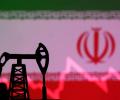
The Trump administration has sanctioned entities and individuals from India involved in sales of Iran's petroleum and petroleum products, saying the funds from this trade support Tehran's regional terrorist proxies and procure weapons systems that are a direct threat to the US.

India is one of the few nations, and perhaps the only nation, that has good relations with America, Israel and Iran. Knowing that a war in the Gulf would damage our economy, hurt supply of fertilisers and fuel, and cause general chaos, we should have tried to ensure this war did not begin, asserts Aakar Patel.

Saudi Arabia and the UAE are actively pushing Trump to take the war to its bitter finish and 'erase' Iran's presence in the geopolitics of the region. Simply put, the two most powerful Sunni Arab oligarchies are on the same page as Israel. Such interference increases the risk of a breakdown in dialogue between the US and Iran, points out Ambassador M K Bhadrakumar.

We cannot simply have a 60-65 per cent import dependency in LPG, the bulk of which comes from just one volatile region -- West Asia, points out R Jagannathan.

Opposition parties are demanding a full Parliament discussion on the West Asia conflict, criticising the government's silence and calling for a contingency plan to protect India's energy security and citizens.

Prime Minister Narendra Modi addressed the Israeli Parliament, reaffirming India's support for Israel in the face of terrorism and expressing support for the Gaza peace initiative.

'I suspect that Bangladesh being given permission stuck in India's official craw, and this story was an attempt to balance the scales by giving the impression that a similar waiver had been given to India as well.'

America's population and its media and its democratic structures seem fine with this, which is why Trump continues as he does, asserts Aakar Patel.

Iran was the chance to arrange a concert of nations, to actually be a Vishwaguru. Instead, we are watching from the sidelines as Pakistan, the same country that is apparently still at war with Afghanistan, hosts talks between US-Israel and Iran. The irony is hard to miss, points out Amberish K Diwanji.
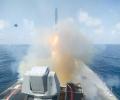
'India was not obliged to protect the Iranian ship.' 'Once the Iranian ship left Indian waters, she was on her own.' 'Guilt tripping India is wrong.'

The United States' historical strategic alignment with Pakistan, dating back to the Cold War, has consistently aimed to create a political and military parity with India, despite India's significantly larger size and resources. This long-standing relationship continues to influence regional dynamics, particularly in West Asia and the Indo-Pacific.

The government has sharply reduced excise duty on petrol to 3 and diesel to zero, offering major relief to consumers. Here's how the price cut will impact fuel rates and inflation.

13 films from the 2026 Cannes film festival, highlighting award-winning international cinema, unexpected gems, and restored classics that truly celebrated the art of filmmaking.

The Ministry of External Affairs on Wednesday said the evacuation of 348 Indian nationals from strife-torn Yemen was a national effort involving various aspects of the country's assets like the Air Force, Navy and Air India.

Indian refiners have access to only limited Iranian volumes compared with Russian oil, and even the barrels on offer come with 'too many hassles'.

Trump has made similar claims many times since May 10 last year, stating that it was his pressure that led to peace between the two nuclear-armed neighbours as he makes his pitch for the Nobel Peace Prize.
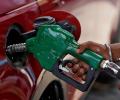
Petrol diesel price today March 20, 2026: IOCL & HPCL hike premium petrol (XP95, Speed, Power) by 2/litre and industrial diesel by 22/litre. Regular petrol in Delhi 94.77, diesel 87.67 unchanged. Full city-wise rates inside.

'If movement remains stalled for three to four months, more than 300,000 recruitments from India could be affected.'

US President Donald Trump and Russian President Vladimir Putin discussed the Iran conflict and its impact on global energy supplies during a phone call.

Israel and the United States had a plan. Iran punched back. And now the Gulf is reeling, the world is beginning to feel the pain and, as on date, no one in Washington or Tel Aviv appears willing to admit that the punch has landed, notes Prem Panicker, continuing his must-read blog on the war in the Middle East.

Nobody takes Pakistan seriously and therefore Pakistan's sudden mediating with almost immediate results of a ceasefire seems more contrived than real, points out Vice Admiral Biswajit Dasgupta (retd).
